



As the global market for Battery Energy Storage Systems (BESS) continues to grow, choosing the right battery cell technology has become increasingly important for EPC companies, project developers, and commercial & industrial (C&I) energy storage investors.
Among current lithium iron phosphate (LFP) battery technologies, 280Ah battery cells and 314Ah battery cells are two of the most widely discussed options in the energy storage industry.
But what are the real differences between 280Ah and 314Ah battery cells?
Which one is better for utility-scale ESS projects, solar-plus-storage applications, and microgrid systems?
Item | 280Ah Battery Cell | 314Ah Battery Cell |
Battery Chemistry | LFP | LFP |
Nominal Capacity | 280Ah | 314Ah |
Typical Cell Energy | ~896Wh | ~1005Wh |
Energy Density | Standard | Higher |
Industry Maturity | Very mature | New-generation mainstream |
Typical Applications | C&I ESS, mature projects | Utility-scale BESS, high-density ESS |
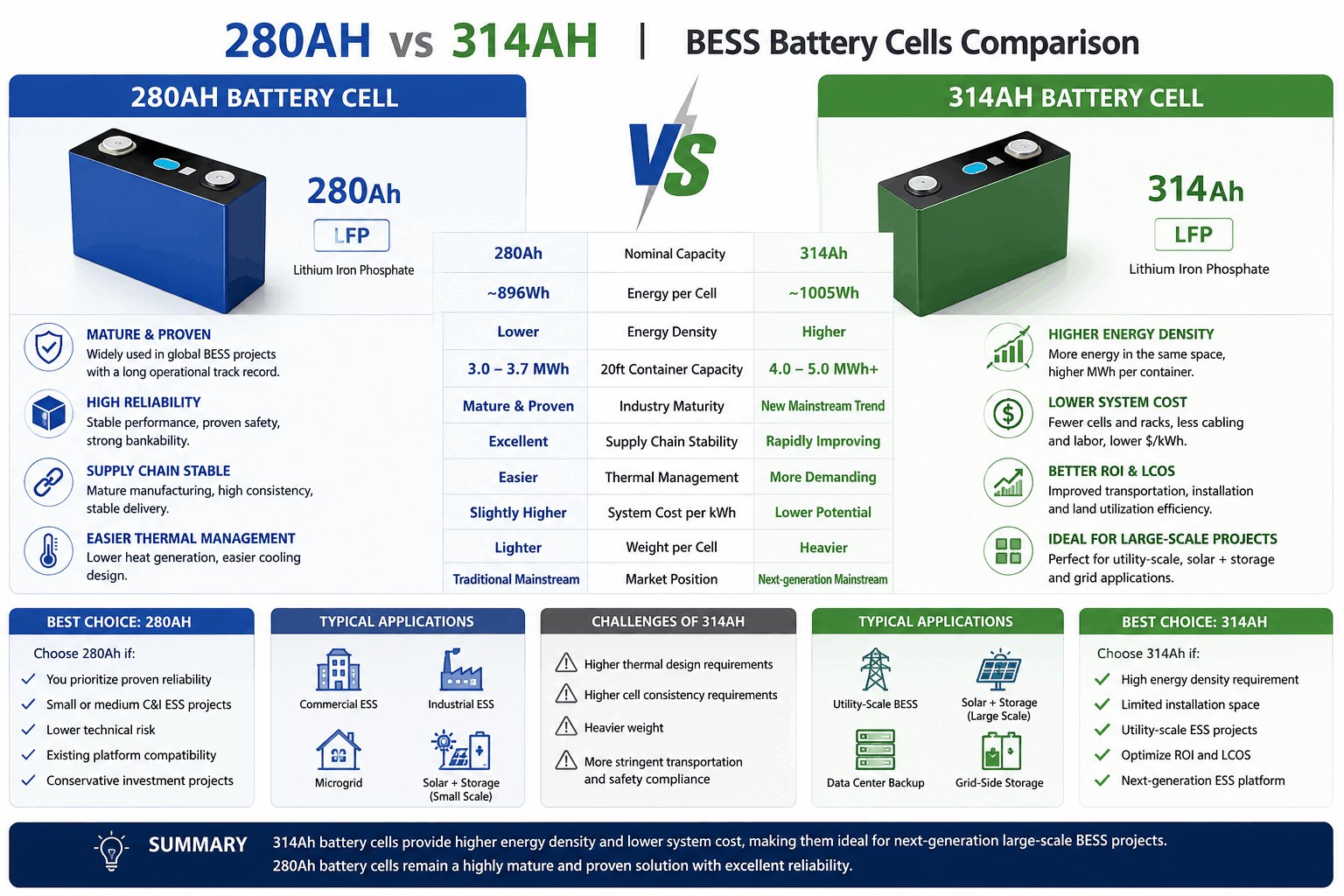
280Ah vs 314Ah: The Core Difference
The biggest advantage of 314Ah battery cells is: Higher Energy Density
Compared with 280Ah cells, 314Ah cells can store more energy within the same installation footprint. This helps achieve:
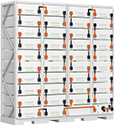
Higher MWh capacity per container
Reduced battery rack quantity
Lower BOS (Balance of System) cost
Reduced cabling and installation complexity
Better land utilization
For example:
A 20ft BESS container using 280Ah cells typically achieves:
Around 3MWh–3.7MWh
A 20ft liquid-cooled BESS container using 314Ah cells can achieve:
Around 4MWh–5MWh+
This is one of the key reasons why 314Ah battery cells are rapidly becoming the mainstream choice for utility-scale energy storage systems.
Advantages of 280Ah Battery Cells
Although 314Ah is becoming more popular, 280Ah battery cells still have major advantages.
1. Mature and Proven Technology
280Ah LFP cells have been widely deployed for years across:
Solar energy storage projects
C&I ESS systems
Microgrid applications
Grid-side energy storage
Their long operational history provides:
Stable performance
Proven safety
Strong bankability
Easier project acceptance
2. Better Supply Chain Stability
The manufacturing process for 280Ah cells is highly mature. Benefits include:
High production consistency
Stable delivery timelines
Lower technical risk
Strong compatibility with existing PCS and BMS platforms
This is especially important for international EPC projects.
3. Easier Thermal Management
Compared with larger-capacity battery cells, 280Ah cells are generally easier to manage thermally. This helps:
Improve temperature consistency
Reduce thermal runaway propagation risk
Simplify cooling system design
Advantages of 314Ah Battery Cells
1. Higher Energy Density
314Ah cells allow:
More energy storage per rack
Higher container energy density
Lower project footprint
This is particularly valuable for:
Utility-scale BESS
Data center backup systems
Large renewable energy projects
2. Lower System-Level Cost
Because fewer cells are required to achieve the same system capacity, 314Ah ESS systems can reduce:
Rack quantity
Busbar usage
Cable quantity
BMS node count
Installation labor
As a result, the overall ESS system cost per kWh can be lower.
3. Improved Project ROI
Higher energy density can improve:
Transportation efficiency
Installation efficiency
Land utilization
Long-term Levelized Cost of Storage (LCOS)
For large-scale investors, this directly impacts project profitability.
Challenges of 314Ah Battery Cells
Despite the advantages, 314Ah battery cells also introduce new engineering requirements.
1. Higher Thermal Design Requirements
Larger-capacity battery cells generate more concentrated heat.
Therefore, advanced thermal management becomes increasingly important, especially in liquid-cooled BESS systems.
2. Higher Cell Consistency Requirements
As cell capacity increases, manufacturers must maintain:
Better internal resistance consistency
More accurate cell balancing
Higher production precision
This places greater demands on battery manufacturing quality.
3. Transportation and Compliance Challenges
Higher energy density also means:
Heavier battery racks
More stringent transportation regulations
Stricter fire safety compliance requirements
System integrators must carefully consider:
NFPA standards
Local grid compliance requirements
Which Battery Cell Is Better for BESS Projects?
Choose 280Ah Battery Cells If:
You prioritize proven long-term reliability
Your project is a small or medium-sized C&I ESS system
You prefer lower technical risk
Existing system platforms already support 280Ah architecture
Suitable for:
Commercial ESS
Industrial ESS
Conservative investment projects
Emerging energy storage markets
Choose 314Ah Battery Cells If:
Your project requires high energy density
Installation space is limited
You are developing utility-scale BESS projects
You want to optimize ROI and LCOS
Suitable for:
Solar-plus-storage plants
Grid-scale energy storage
Renewable integration projects
Large microgrid systems
Future Trend of Energy Storage Battery Cells
The global energy storage industry is clearly moving toward larger-capacity battery cells, including:
3.2V 314Ah
3.2V 587Ah
3.2V 628Ah
Driven by:
Utility-scale ESS demand
AI data center power demand
Renewable energy integration
Lower LCOS requirements
However, 280Ah battery cells will continue to remain important because of their mature ecosystem and proven reliability.
Final Conclusion
Both 280Ah and 314Ah battery cells are excellent choices for modern lithium battery energy storage systems.
280Ah battery cells offer mature technology, strong reliability, and lower operational risk.
314Ah battery cells provide higher energy density, lower system cost, and better long-term project economics.
For most next-generation utility-scale BESS projects, 314Ah battery cells are becoming the preferred solution.
For conservative or medium-scale ESS projects, 280Ah battery cells still remain a highly competitive option.