




Air Cooling vs. Liquid Cooling: Choosing the Right Thermal Management for Your BESS
In the rapidly evolving landscape of Battery Energy Storage Systems (BESS), thermal management is the heartbeat of system performance. As the industry shifts toward higher energy densities and larger cell capacities (such as 314Ah cells), the debate between Air Cooling and Liquid Cooling has moved to the forefront of project planning.
Understanding the technical nuances of these two technologies is critical for optimizing your Levelized Cost of Storage (LCOE) and ensuring long-term grid stability.
1. Air Cooling: The Proven, Cost-Effective Standard
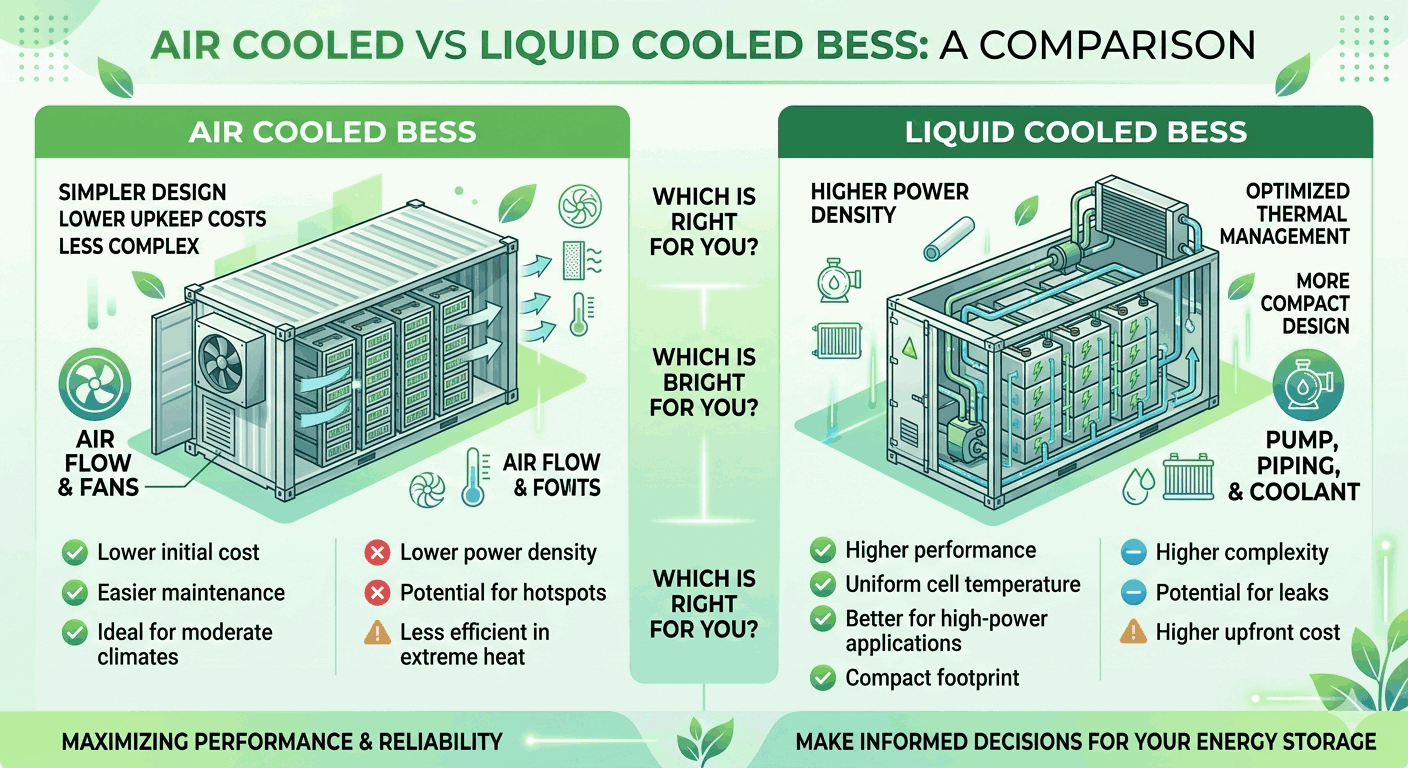
Air cooling systems utilize forced convection, where fans circulate ambient or chilled air through the battery racks to dissipate heat.
Low CAPEX: With a simpler architecture—comprising mainly fans and HVAC units—air-cooled systems offer a lower initial investment.
Ease of Maintenance: Maintenance is straightforward, typically involving filter cleanings and fan replacements, requiring no specialized hydraulic expertise.
Operational Safety: The absence of liquid inside the battery enclosure eliminates the risk of coolant leaks, which can lead to insulation failures or short circuits.
Best For: Small-to-medium commercial & industrial (C&I) projects, and regions with moderate ambient temperatures.
2. Liquid Cooling: The Future of High-Density Storage
Liquid cooling employs a coolant (usually a water-glycol mixture) circulating through cold plates in direct contact with battery modules.
Superior Thermal Consistency: Liquids have a much higher heat capacity than air. Liquid cooling can maintain cell temperature differentials within ±3°C, significantly slowing down SOH (State of Health) degradation.
Compact Footprint: By eliminating bulky internal air ducts, liquid-cooled containers can achieve massive energy densities—often exceeding 5MWh in a standard 20ft container.
Lower Parasitic Power: At high discharge rates, liquid cooling is more energy-efficient, reducing the "auxiliary power" consumption of the BESS itself.
Best For: Utility-scale projects, high-power applications (1C or higher), and harsh climates with extreme heat.
Technical Specification Comparison
| Feature | Air Cooled BESS | Liquid Cooled BESS |
| Heat Dissipation Efficiency | Moderate | Excellent |
| Temperature Uniformity | $\approx 5-8^\circ\text{C}$ | $\leq 3^\circ\text{C}$ |
| Energy Density | Standard | Ultra-High (Save up to 40% space) |
| Maintenance Profile | Low Complexity | Technical (Requires pressure checks) |
| Service Life | Standard | Extended (Due to better thermal control) |
Summary: Which System Should You Choose?
The decision ultimately hinges on your project’s specific KPIs. If initial budget and simplicity are your primary drivers, Air Cooling remains a reliable choice for standard industrial applications.
However, if you are looking to maximize ROI through higher energy density, lower land-use costs, and superior battery longevity, Liquid Cooling is the clear winner for the next generation of energy storage.
Looking for a turnkey BESS solution?
Our engineering team provides optimized EPC services for microgrids, mining, and industrial parks. Contact us today for a technical consultation tailored to your regional grid requirements.
How does this structure look for your website's "Technical Insights" section?