



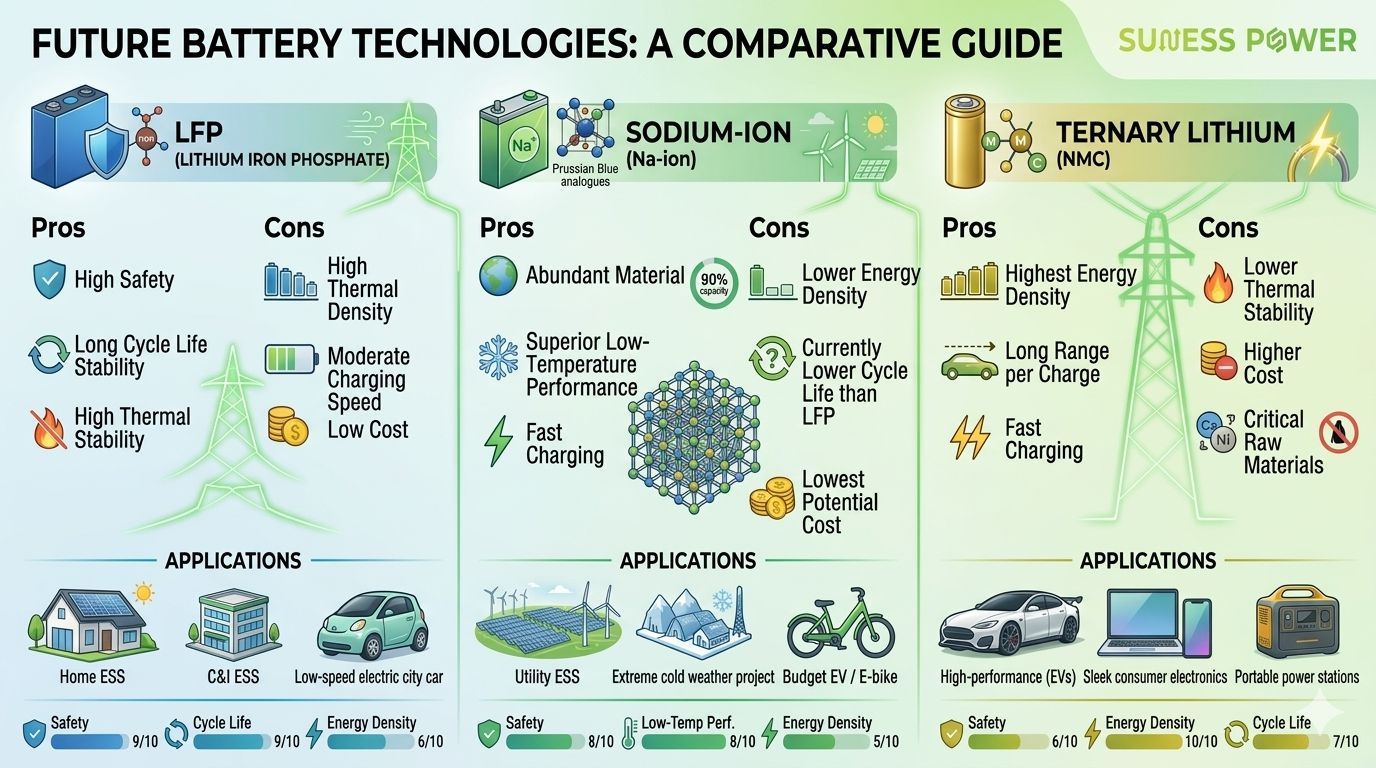
| Feature / Technology | LFP (Lithium Iron Phosphate) | Sodium-ion (Na-ion) | NMC (Ternary Lithium) |
| Safety & Stability | Excellent (High thermal runaway threshold) | Excellent (Extremely safe, non-flammable) | Moderate (Requires advanced BMS cooling) |
| Cycle Life | Very High (4,000 – 6,000+ cycles) | High (2,000 – 4,000+ cycles) | Moderate (1,500 – 2,500 cycles) |
| Energy Density | Moderate (140–180 Wh/kg) | Low to Moderate (100–150 Wh/kg) | High (200–300 Wh/kg) |
| Low-Temp Performance | Fair (Capacity drops below 0°C) | Excellent (Retains >85% capacity at -20°C) | Good (Better than LFP in cold climates) |
| Cost Efficiency | High (Cobalt-free, cost-effective) | Maximum Potential (Abundant raw materials) | Low to Moderate (Slightly premium due to Nickel/Cobalt) |
| Environmental Impact | Eco-friendly (Low toxicity) | Highest Sustainability (Abundant & easy to recycle) | Moderate (Heavy metal recycling required) |
| Best For (Applications) | Residential & Commercial ESS, Telecom Base Stations, Electric Buses. | Grid-scale Peak Shaving, Low-speed EVs, Extreme Weather Energy Storage. | High-performance EVs, Premium Portable Power Stations, Space-constrained Apps. |
Which one is right for your project?
Choose LFP for Long-Term Reliability: Ideal for stationary energy storage systems (ESS). It offers the lowest cost per cycle and the ultimate peace of mind for residential and commercial solar setups.
Choose Sodium-ion for Extreme Climates & Sustainability: The next-generation choice for large-scale grid storage, especially in extremely cold regions or projects prioritizing green supply chains and cost-efficiency.
Choose NMC for Maximum Power & Compact Spaces: When high energy density, lightweight design, and long-range mobility are your absolute priorities.