






AC Coupling vs. DC Coupling in BESS: Key Differences, Benefits, and Best Use Cases
As the global demand for Battery Energy Storage Systems (BESS) accelerates—especially in emerging markets like Latin America and Africa—choosing the right system architecture is no longer optional. One of the most critical design decisions is whether to adopt AC coupling or DC coupling.
What Is AC Coupling in BESS?
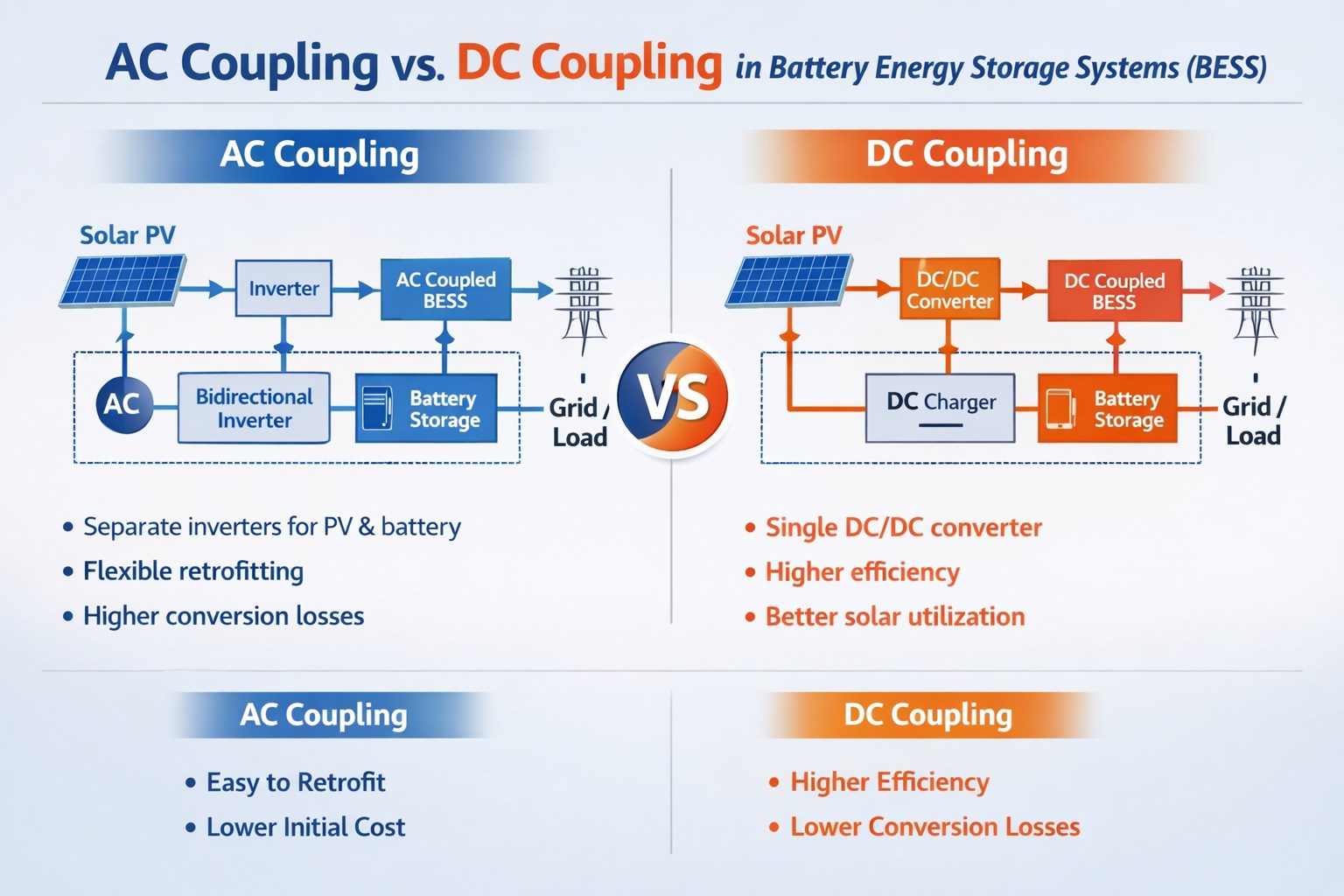
AC coupling connects the solar PV system and battery storage on the AC side of the electrical system.
How It Works
Solar panels generate DC power
A PV inverter converts DC → AC
Electricity flows to loads or grid
A bidirectional inverter converts AC ↔ DC to charge/discharge the battery
Key Features
Separate inverters for PV and battery
Energy passes through multiple conversion stages
Advantages of AC Coupling
Flexible retrofitting
Ideal for upgrading existing grid-tied solar systems without redesigning the entire setup.
Lower initial investment
No need to replace existing PV inverters.
System independence
PV and storage systems can operate separately, improving operational flexibility.
Disadvantages
Higher conversion losses
Multiple DC↔AC conversions reduce overall efficiency (typically 2–4% lower than DC coupling).
More complex system control
Requires synchronization between multiple inverters.
What Is DC Coupling in BESS?
DC coupling connects solar PV and battery storage on the DC side, before inversion.
How It Works
Solar panels generate DC power
Power flows through a DC/DC converter
Battery stores energy directly in DC form
A single inverter converts DC → AC for grid/load use
Key Features
Shared inverter for both PV and storage
Fewer conversion steps
Advantages of DC Coupling
Higher system efficiency
Reduced conversion stages improve round-trip efficiency (up to 95–98%).
Better solar utilization
Excess PV energy can be stored directly instead of being curtailed.
Lower long-term operational cost
Less energy loss = higher ROI over project lifetime.
Disadvantages
Less flexible for retrofits
Requires redesign or replacement of existing PV systems.
Higher upfront engineering complexity
System integration and control are more sophisticated.
| Feature | AC Coupling | DC Coupling |
|---|---|---|
| System Efficiency | Medium | High |
| Conversion Loss | Higher | Lower |
| Retrofit Capability | Excellent | Limited |
| Initial Cost | Lower | Moderate |
| System Complexity | Medium | Higher |
| Solar Utilization | Moderate | High |
| Best Use Case | Existing PV upgrades | New installations |
Real-World Applications
1. Residential & Small Commercial Systems
AC Coupling is dominant
Reason: Easy integration with existing rooftop solar
Example: Home solar + battery retrofit projects
2. Commercial & Industrial (C&I) ESS
Hybrid usage
AC for flexibility, DC for efficiency-driven projects
3. Utility-Scale Solar + Storage
DC Coupling is preferred
Maximizes energy yield and reduces curtailment
Ideal for:
Peak shaving
Energy arbitrage
Grid stabilization
Industry Trends (2025–2027)
DC coupling is rapidly gaining market share, especially in utility-scale projects
Hybrid architectures (AC + DC) are emerging for complex grids
Increasing demand for AI-driven EMS (Energy Management Systems) to optimize both architectures
Policy incentives in markets like Argentina and Brazil favor higher efficiency systems, boosting DC adoption
Which One Should You Choose?
Choose AC Coupling if:
You are retrofitting an existing PV system
Budget constraints are critical
You need maximum flexibility
Choose DC Coupling if:
You are building a new solar + storage project
You want maximum ROI and efficiency
Curtailment reduction is a priority
Expert Insight: ROI vs Flexibility
In today’s market, the decision often comes down to:
Short-term savings → AC Coupling
Long-term performance → DC Coupling
For developers targeting utility-scale or high electricity price markets, DC coupling typically delivers better lifecycle economics despite higher initial complexity.
Conclusion
Both AC and DC coupling play essential roles in modern BESS design. The right choice depends on project stage, budget, and performance goals.
AC coupling offers simplicity and retrofit flexibility
DC coupling delivers superior efficiency and energy yield
As global energy markets evolve, understanding these architectures is key to building competitive, future-proof energy storage solutions.